AI IVR: How to replace legacy IVR with voice AI
NaN
AI IVR: How to replace legacy IVR with voice AI


“Press 1 for sales. Press 2 for support. Press 3 for billing.”
Traditional IVR has been the front door to the contact center for decades. But for many callers, it has also become one of its biggest sources of friction.
Customers rarely think about their problem in terms of a company’s internal phone tree. They want to explain why they are calling, get an answer and move on.
AI IVR changes that interaction.
Instead of forcing callers through fixed menus, an AI-powered IVR can understand natural language, identify intent, access relevant information, complete supported tasks and route more complex conversations to the right person.
For organizations running established PBX, SIP or contact center infrastructure, modernization does not necessarily mean replacing the entire phone system either. Voice AI can be introduced as a new intelligence layer within the existing environment.
What is AI IVR?
AI IVR is an interactive voice response system that uses technologies such as speech recognition, natural language understanding and large language models to understand what callers are asking in their own words.
A traditional IVR might say:
“For billing, press 1. For technical support, press 2.”
An AI IVR can instead ask:
“How can I help you today?”
A caller might respond:
“I was charged twice for my last order and I want to know whether one of the payments has been refunded.”
Rather than trying to map that request to a numbered menu, the AI can identify the caller’s intent, ask for any information it needs, access connected systems and determine the appropriate next action.
Depending on the workflow, that might mean:
answering the question directly;
checking an account or order;
collecting information;
completing an approved task;
routing the call to the appropriate team; or
escalating the conversation to a human.
This is why terms such as AI IVR, conversational IVR, intelligent IVR and AI voice IVR are increasingly used to describe the next generation of automated phone experiences.
Traditional IVR vs conversational AI IVR
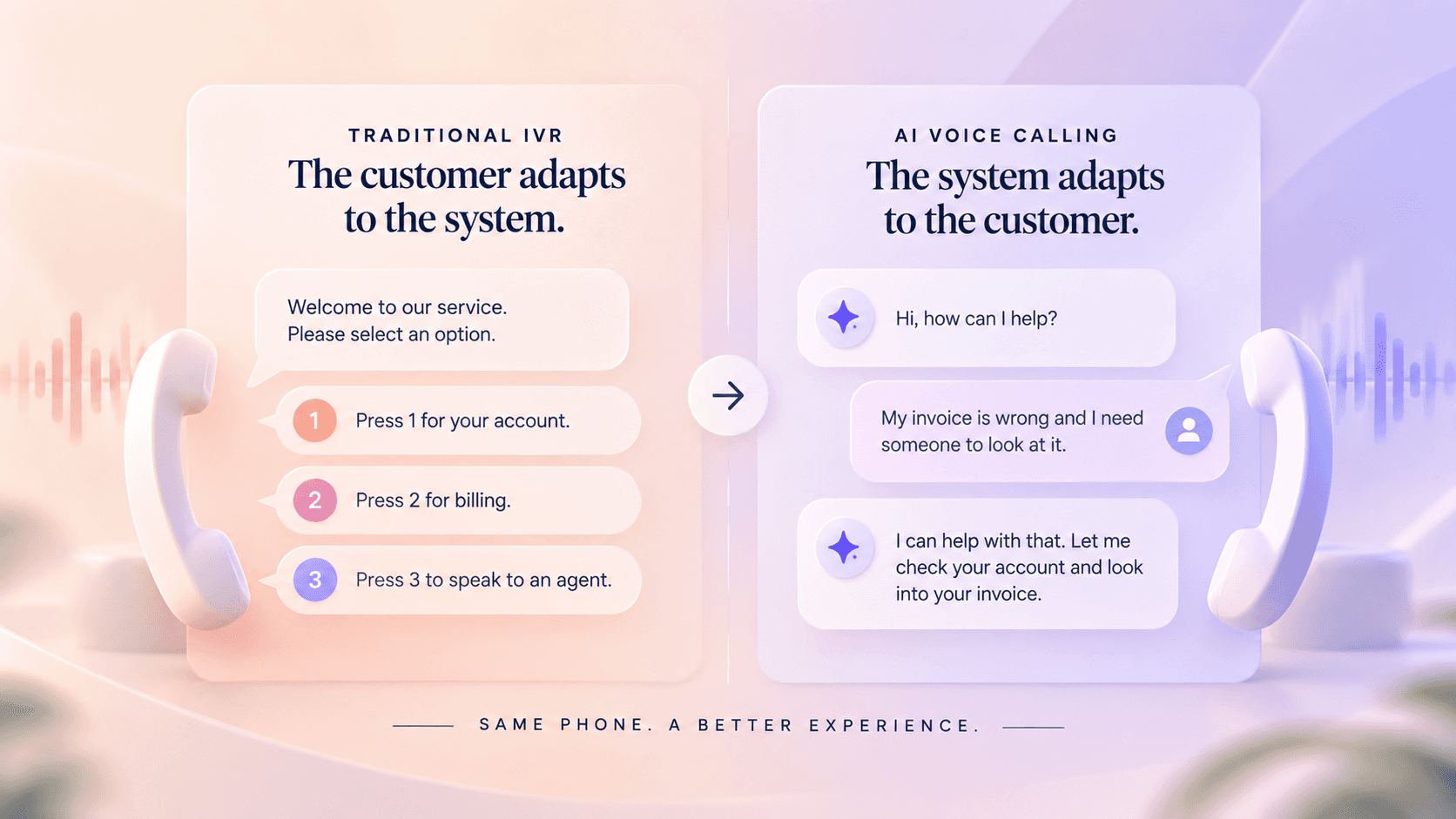
The biggest difference is not simply that one uses buttons and the other uses speech.
It is the way the interaction is designed.
Traditional IVR | Conversational AI IVR |
|---|---|
Follows predefined phone trees | Understands natural-language requests |
Relies on keypad inputs or limited commands | Lets callers explain what they need |
Primarily routes calls | Can resolve supported requests |
Loses context when callers move between flows | Can maintain context across the conversation |
Requires callers to fit predefined options | Identifies intent from the caller's words |
Escalates based on fixed menu paths | Can escalate based on intent, rules or confidence |
Difficult to adapt to unexpected requests | Can ask clarifying questions |
Human agents often receive limited context | Handoffs can include conversation context |
Older voice-activated IVRs improved on touch-tone menus by allowing callers to say predefined phrases such as “billing” or “technical support.”
Conversational IVR goes further. The system is designed to understand variations in how people naturally describe the same problem and maintain context across multiple turns.
Why are companies replacing legacy IVR?
Traditional IVR still works well for predictable routing. The problem appears when increasingly complex customer journeys are forced into rigid decision trees.
Consider a caller who says:
“I changed my address last week, but my replacement card still went to the old one.”
Where does that belong?
Account management? Cards? Delivery? Complaints?
A customer understands the request immediately. A traditional IVR does not.
This leads to several familiar problems.
Long and complicated phone trees
As organizations add teams, products and services, IVR menus grow.
A simple three-option menu can eventually become layers of submenus where callers repeatedly choose the closest available option rather than the correct one.
Misrouted calls
When callers cannot find an option matching their problem, they guess.
The result is often a transfer to the wrong queue followed by another transfer once a human understands what they actually need.
Repetition
Customers may explain the problem to the IVR, then repeat it after reaching an agent because the context was not transferred with the call.
Limited automation
Traditional IVR is good at collecting simple inputs and routing calls, but many interactions still end in a queue.
An intelligent IVR can potentially go beyond routing and complete supported actions during the conversation.
Difficult maintenance
Complex menu trees require constant updates as products, processes and teams change.
Over time, this can leave organizations maintaining hundreds of branches in flows that few people fully understand.
Does AI IVR replace the entire phone system?
Not necessarily.
This is an important distinction when planning legacy IVR replacement.
Replacing the customer-facing IVR experience does not have to mean replacing the PBX, contact center platform, phone numbers or routing infrastructure behind it.
For enterprises with established telephony, an AI voice layer can integrate with existing infrastructure through technologies such as SIP and APIs.
A simplified architecture might look like:
Caller → existing telephony → AI voice agent → business systems / knowledge → existing queues and human agents
This allows organizations to modernize the interaction gradually while preserving the infrastructure they still rely on.
Instead of starting with:
“Which phone system should we migrate to?”
the question can become:
“Where can we introduce conversational AI into the call flow we already have?”
That can significantly reduce the scope of an IVR modernization project.
How to replace IVR with AI
A successful IVR replacement should not begin by recreating every branch of the old phone tree inside an AI system.
The better approach is to identify what callers are actually trying to accomplish and design around those intents.
1. Map your existing call flows
Start with the current IVR.
Identify:
the highest-volume call reasons;
where callers abandon;
the most common transfers;
which flows regularly reach human agents;
frequently repeated questions;
tasks that already have APIs or system integrations; and
calls where human judgment is genuinely required.
Your existing IVR data can be useful here. It shows which journeys are common and where customers struggle.
The goal is not to replicate the phone tree.
It is to understand the demand behind it.
2. Choose the first workflows to automate
Do not start with every possible call.
Choose a controlled group of high-volume, predictable interactions.
For example:
checking an order;
changing an appointment;
requesting an account balance;
checking opening hours;
qualifying an inquiry;
updating basic customer information; or
routing callers based on their actual reason for calling.
These workflows make it easier to measure whether AI IVR is improving the customer experience before expanding into more complex conversations.
3. Connect the AI to the right information
An AI voice agent is only useful if it can access the information needed to respond accurately.
That may include:
approved knowledge bases;
CRM records;
customer support platforms;
booking systems;
order management systems;
product documentation;
internal APIs; and
other systems of record.
For enterprise deployments, this should be controlled.
Giving an AI agent access to more information is not automatically better. The system should have access to the information required for the specific workflow and clear rules around what it is allowed to disclose or change.
4. Define what the AI can and cannot do
This is one of the most important parts of an AI IVR implementation.
A traditional IVR is predictable because its available paths are explicitly defined.
Conversational AI introduces more flexibility, but organizations still need boundaries.
Define:
which questions the AI can answer;
which actions it can perform;
what requires authentication;
what information it can access;
what information it can reveal;
when clarification is required;
when the AI should stop trying to resolve the request; and
when a human should take over.
A good AI IVR should not be measured by whether it attempts to answer every question.
It should also know when not to answer.
5. Design human escalation from the beginning
Replacing IVR with AI does not mean removing humans from the call center.
Some conversations are complex, sensitive or simply outside the information available to the AI.
For example, imagine a customer asks a detailed technical question that is not covered in the approved knowledge available to the voice agent.
The system should not improvise an answer simply to keep the caller contained.
Instead, it can:
recognize that confidence is low;
collect the information a human specialist will need;
alert or route to the appropriate team; and
transfer the conversation with context.
This creates a different objective from traditional IVR containment.
The goal is automation where appropriate and human involvement where it adds value.
6. Test difficult calls, not just perfect ones
A demo where a customer asks a simple question proves very little.
Before deploying an AI IVR, test what happens when callers:
interrupt the agent;
change their mind;
give incomplete information;
speak with background noise;
use different accents;
ask several questions at once;
request a human immediately;
provide unexpected information;
ask something outside the knowledge base;
become frustrated; or
trigger an unavailable backend system.
These situations are where conversational systems are genuinely tested.
7. Introduce AI IVR gradually
For large contact centers, a phased rollout is usually more practical than replacing every IVR flow at once.
You might initially route a percentage of calls or one specific workflow to the AI agent while keeping the existing IVR available as a fallback.
Measure performance, review calls and expand once the system performs reliably.
This also gives operational teams the opportunity to understand where human supervision, escalation rules and knowledge need improving.
What should you look for in an AI IVR solution?
There is no single “best AI IVR solution” for every organization.
A company running a simple business phone line has very different requirements from an enterprise contact center with existing PBX infrastructure, multiple systems and regulated customer data.
When evaluating an intelligent IVR platform, look beyond how realistic the voice sounds.
Natural language understanding
Callers should be able to describe their request naturally rather than memorizing commands.
Context across the conversation
If a caller provides information at the beginning of a call, the AI should not repeatedly ask for the same details.
Real-world system integrations
The agent needs a secure way to access the CRM, knowledge base, scheduling platform or other systems required to resolve the interaction.
Human handoff
There should always be a clear path to a person when the AI reaches the limit of what it can safely or effectively handle.
Ideally, that handoff includes the context already collected so the customer does not have to start again.
Live visibility
Organizations should be able to see what their AI agents are doing rather than treating voice automation as a black box.
For complex or high-value calls, real-time monitoring and human intervention can provide an additional layer of control.
Existing telephony compatibility
Ask whether implementing the AI requires replacing the current PBX or contact center platform.
For enterprises with significant existing infrastructure, an AI IVR that can connect to the current environment may allow modernization without a large telephony migration.
Governance and security
Understand:
where recordings and transcripts are stored;
who can access them;
retention controls;
authentication;
data access;
logging;
escalation policies; and
what data the AI can use during a conversation.
These questions become increasingly important as the AI moves from simple routing to taking actions on behalf of customers.
AI IVR is more than a better phone menu
It is tempting to think of conversational AI as a more natural version of the same IVR.
But replacing:
“Press 1 for billing.”
with:
“Tell me what you're calling about.”
is only the first step.
The real opportunity is to move from routing calls to resolving appropriate calls.
An AI voice agent can understand the request, gather context, retrieve information, complete supported actions and involve a human when the conversation requires one.
And for companies with established telephony infrastructure, that transition does not necessarily require ripping everything out and starting again.
Modernize your IVR without replacing your telephony stack
Callab AI brings conversational voice AI into existing enterprise telephony environments.
Connect AI voice agents to your current PBX, SBC and SIP infrastructure, automate the workflows that make sense, and keep humans able to supervise and intervene when a conversation needs them.
Map your existing telephony architecture and identify where AI could fit in 30 minutes. No commitment.
What is AI IVR?
What is conversational IVR?
How do I replace IVR with AI?
Do I need to replace my PBX to use AI IVR?
What happens when the AI IVR cannot answer a question?
Can an AI IVR transfer calls to human agents?
What is the difference between voice-activated IVR and AI IVR?
How do you set up an AI IVR?
AI IVR: How to replace legacy IVR with voice AI
Related posts
IVR to AI Transition
AI IVR: How to replace legacy IVR with voice AI
Learn how AI IVR replaces rigid phone menus with natural conversations, intelligent routing and automated resolution, without replacing your existing telephony stack.
Voice AI
AI Voice Calling: What it is, how it works, and how businesses use it
Learn what AI voice calling is, how AI phone calls work, where businesses use them, and what to consider when deploying AI calling at scale.

Enterprise Voice AI
Telephony Infrastructure
How to Evaluate a Voice AI Provider for Enterprise Contact Centers
A 10-point infrastructure checklist for enterprise contact center teams evaluating voice AI providers. Nearly 60% of agent seats still run on-premises telephony that most providers cannot natively reach.