AI Voice Calling: What it is, how it works, and how businesses use it
NaN
AI Voice Calling: What it is, how it works, and how businesses use it


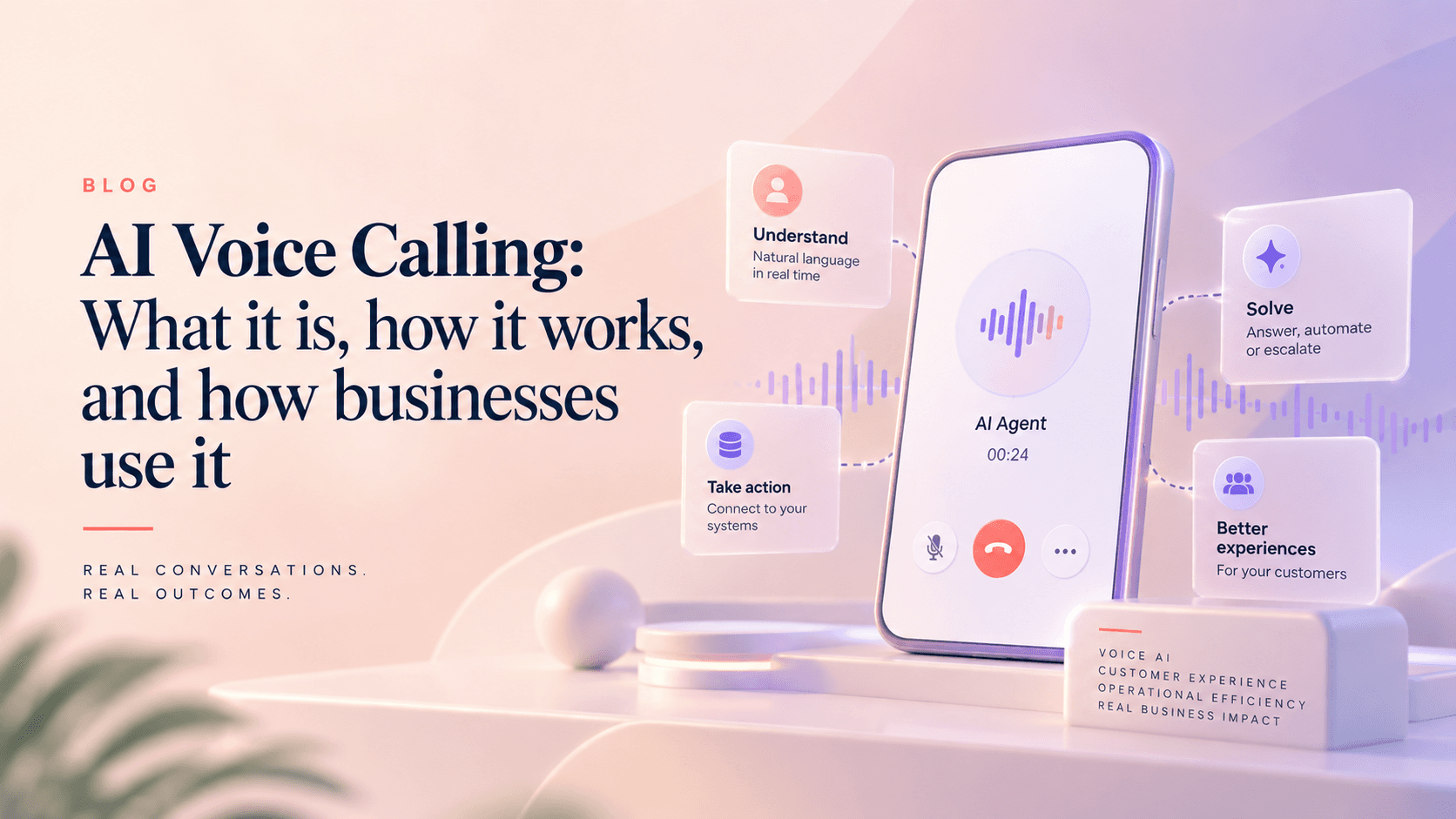
AI voice calling is changing what businesses can automate over the phone.
Instead of relying on rigid IVR menus, pre-recorded messages or simple outbound dialers, businesses can now deploy AI voice agents that listen, understand, respond and take action during a live phone conversation.
That opens up a much wider range of possibilities.
An AI agent can qualify a lead, answer a customer question, book an appointment, confirm an order or follow up with hundreds of customers without requiring a human agent to manage every interaction.
But AI voice calling isn't simply about making phone calls with a synthetic voice.
For businesses deploying it at scale, the bigger questions are how the AI connects to existing systems, what it is allowed to do, how calls are monitored and what happens when a conversation requires human judgment.
Here's how AI voice calling works and what businesses should consider before deploying it.
What is AI voice calling?
AI voice calling is the use of artificial intelligence to conduct inbound or outbound phone conversations with customers in real time.
Unlike traditional automated calls that play a fixed recording or follow a predetermined menu, modern AI voice agents can understand natural language and generate responses dynamically as the conversation develops.
A customer doesn't have to:
“Press 1 for sales, press 2 for support.”
They can simply say:
“I'm calling because my delivery hasn't arrived.”
The AI can identify the intent, retrieve the relevant information and continue the conversation naturally.
Depending on how the agent has been configured, it can then answer the question, update a system, perform an action or transfer the caller to a person.
How does an AI voice call work?
An AI phone conversation may feel simple to the caller, but several technologies are working together behind the scenes.
At a simplified level, an AI voice call works like this:
1. The customer speaks
The caller's audio is captured during the phone conversation.
2. Speech is converted into text
Speech recognition technology processes what the caller has said so the AI can interpret it.
3. The AI determines what to do
The AI evaluates the caller's request, the conversation so far and any relevant instructions or business information.
It may also retrieve information from a knowledge base, CRM or another connected system.
4. A response is generated
The AI determines the most appropriate response or action.
5. The response becomes speech
Text-to-speech technology converts the response into natural-sounding audio.
6. The conversation continues
This happens repeatedly throughout the call, allowing the customer and AI agent to have a multi-turn conversation.
The best AI calling experiences make this process feel almost invisible.
The customer speaks naturally and receives an appropriate response without needing to understand what's happening underneath.
AI voice calling vs traditional IVR
Automating phone interactions isn't new. Businesses have used Interactive Voice Response systems for decades. What's changing is how flexible those interactions can be.
Traditional IVR systems typically depend on predefined options:
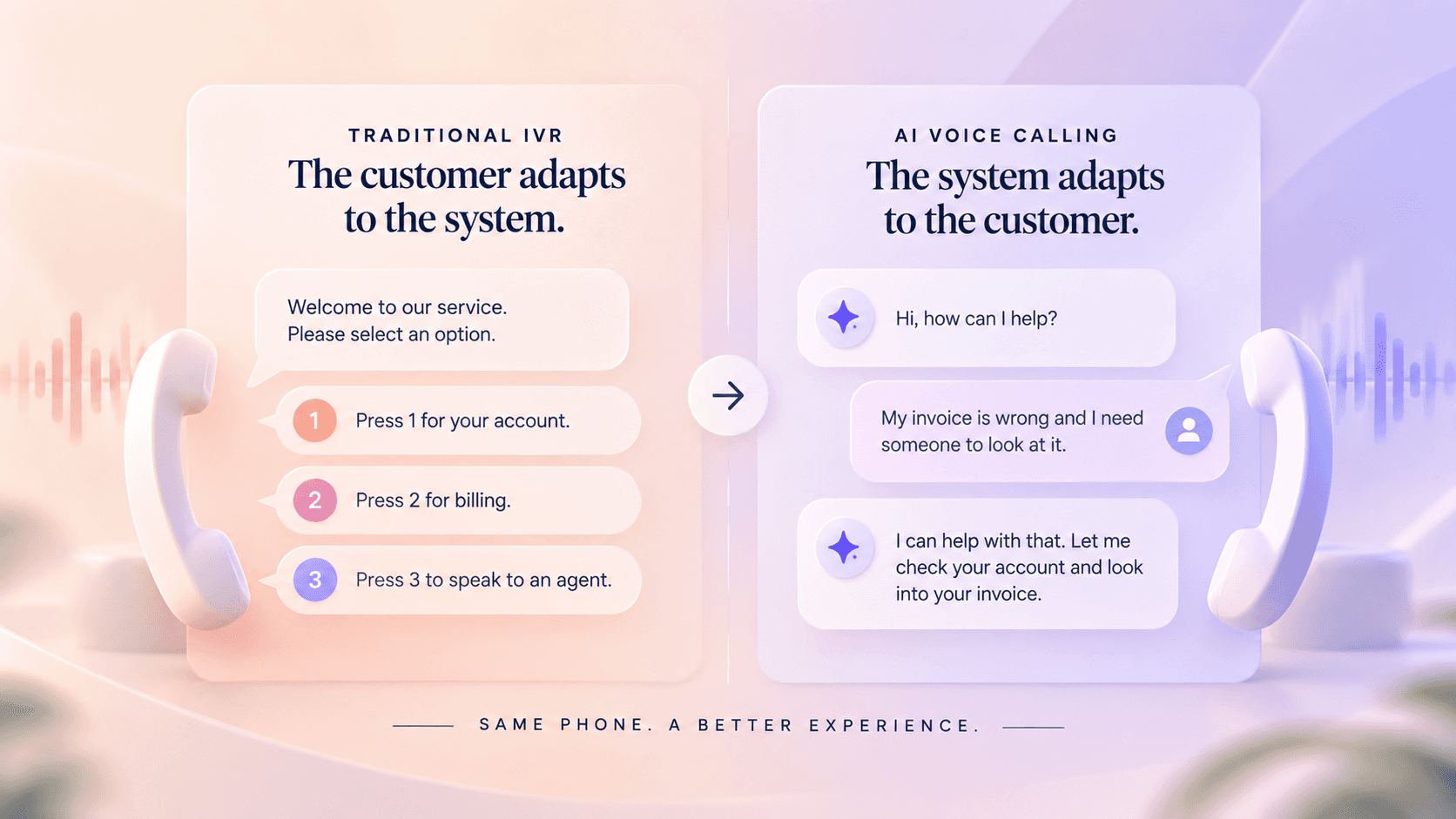
IVR:
The customer has to adapt to the system.
With an AI voice agent, the system can instead adapt to what the customer says.
AI voice calling:
The AI can interpret both the intent and the context of the request.
This doesn't mean every IVR needs to disappear overnight.
Businesses can introduce AI calling gradually, starting with individual workflows and maintaining existing routing or human-agent queues around them.
Inbound vs outbound AI calling
AI voice calling can support both inbound and outbound conversations.
Inbound AI calls
Inbound AI agents answer calls initiated by customers.
Common use cases include:
Customer service
Order status
Appointment scheduling
Reservation management
FAQ handling
Call routing
Basic troubleshooting
Account enquiries
Lead qualification
Instead of placing every caller directly into a human queue, the AI can resolve suitable conversations and escalate others.
Outbound AI calls
Outbound AI agents initiate calls based on a defined workflow or customer list.
Use cases can include:
Lead qualification
Appointment reminders
Customer follow-ups
Delivery updates
Payment reminders
Surveys
Renewals
Booking confirmations
Sales outreach
The important distinction between AI outbound calling and traditional automated dialing is that the AI can respond to what the person actually says.
It's a conversation, rather than simply a recorded message.
Where can businesses use AI voice calling?
The technology can be applied anywhere a business handles a large number of relatively structured conversations.
Customer support
Many contact center calls involve repeatable requests.
Customers want to know where an order is, change an appointment, update an account or ask a common question.
AI voice agents can handle suitable interactions while allowing human agents to focus on more complex cases.
Appointment scheduling
AI agents can book, confirm, cancel or reschedule appointments while interacting with scheduling systems in real time.
This can be particularly useful for businesses receiving calls outside normal operating hours.
Lead qualification
An AI calling agent can contact or answer prospects, ask qualification questions and collect information before routing suitable opportunities to a salesperson.
Retail and e-commerce
AI calls can help customers check orders, ask product questions, manage returns or receive delivery updates.
Hospitality
Hotels and hospitality groups can use AI calling for reservations, booking enquiries, changes and common guest questions.
Collections and payment reminders
AI agents can manage high-volume reminder calls, collect information and escalate conversations that require negotiation or human involvement.
AI calling shouldn't mean AI operating without control
One of the biggest questions for businesses adopting AI is not whether the technology can hold a conversation.
It's what happens when the conversation doesn't go according to plan.
Customers are unpredictable.
A routine enquiry can become a complaint.
A simple appointment change can turn into a sensitive conversation.
A caller can ask something the AI doesn't know.
For enterprise AI calling, businesses therefore need to think beyond automation.
They need control.
That means defining what the AI is allowed to do, what it should never do and when humans need to become involved.
For example, an AI system might flag a conversation when:
Its confidence falls below a threshold
The caller becomes frustrated
The customer explicitly asks for a person
A sensitive topic is raised
Authentication fails
The AI repeatedly misunderstands the request
A high-risk action is required
The objective shouldn't be to remove humans from every call.
It should be to determine where AI can operate effectively while keeping people available when human judgment matters.
Why human supervision matters
Many AI platforms focus on what happens before and after a call.
Businesses configure the agent, send it into production and then review recordings and transcripts afterwards.
For some use cases, that's enough.
For others, waiting until the conversation has ended is too late.
Real-time supervision gives contact center teams another layer of control.
Supervisors can monitor conversations as they happen and identify calls that may require intervention.
For example, Callab surfaces live transcripts alongside sentiment and AI-confidence information, while allowing a supervisor to take over a conversation when necessary.
This creates a different operating model:
AI handles the conversation by default.
Humans supervise the exceptions.
That allows businesses to increase automation without assuming every customer conversation should become fully autonomous.
How does AI calling connect to a phone system?
Another important consideration is telephony.
An impressive AI demo doesn't necessarily tell you how easily the technology will work within an enterprise contact center.
Large organizations may already operate:
On-premise PBXs
Session Border Controllers
SIP infrastructure
Cloud contact center platforms
Multiple carriers
Regional phone systems
Existing IVRs
Complex routing rules
Replacing all of this just to deploy AI may be unnecessary.
AI voice agents can instead be introduced as another endpoint within the existing telephony environment.
For example:
Customer → Existing phone system → AI voice agent
If the AI needs assistance:
AI voice agent → Existing human-agent queue
Callab, for example, connects to existing PBX and SBC environments through SIP, allowing enterprises to introduce AI without migrating their core telephony stack.
We'll cover the architecture behind this in more detail in our guides to AI voice agents for on-premise PBX environments and SIP integrations.
What should you look for in an AI calling platform?
Voice quality is important, but it is only one part of an enterprise deployment.
When evaluating AI voice calling platforms, consider:
1. Conversation quality
Can the agent understand natural speech, interruptions and different ways of asking the same question?
2. Latency
Does the conversation feel natural, or are there long pauses between the customer speaking and the AI responding?
3. Integration
Can the AI access the CRM, knowledge base and business systems required to actually complete the customer's request?
4. Telephony compatibility
Can it work with your current phone system, or will you need to migrate infrastructure?
5. Human escalation
What happens when the AI shouldn't continue independently?
Can it transfer the call while preserving the context of the conversation?
6. Observability
Can your team understand what the AI said, why calls succeeded or failed and where problems are emerging?
7. Supervision
Can people intervene during a conversation, or can calls only be reviewed once they've finished?
8. Security and compliance
Where is data processed? How are calls stored? What controls are available for regulated or sensitive interactions?
The right platform depends on the use case.
An AI agent designed for a small outbound campaign may require very different infrastructure from one handling thousands of enterprise customer-service calls.
How to start with AI voice calling
The safest approach is rarely to automate every phone call immediately.
Start with one clearly defined workflow.
Look for a use case that is:
High-volume
Relatively predictable
Easy to measure
Currently time-consuming for employees
Suitable for escalation when necessary
Then define what success looks like.
That might include:
Calls resolved without human intervention
Average handling time
Successful appointments booked
Qualified leads generated
Transfer rate
Escalation rate
Customer satisfaction
Cost per resolved interaction
Start with a controlled amount of traffic.
Monitor what happens.
Identify where the AI succeeds and where humans still need to intervene.
Then expand.
The future of AI calling isn't simply more automation
It's easy to describe AI voice calling as a replacement for human agents.
That's probably the least interesting way to think about it.
The bigger opportunity is changing how human and AI agents work together.
AI can handle the volume, repetition and structured parts of customer conversations.
People can focus on situations that require empathy, negotiation, judgment or flexibility.
And businesses can decide where that boundary sits.
As AI voice calling matures, the question will increasingly move from:
“Can AI handle this call?”
to:
“How much autonomy should AI have during this call?”
That's why infrastructure, visibility and human supervision matter just as much as voice quality.
Add AI voice calling to your existing contact center
Callab AI helps enterprises deploy AI voice agents into the contact center infrastructure they already use.
Connect your existing telephony, launch a controlled workflow and monitor AI conversations in real time, with humans available to intervene when needed.
Book a demo to explore where AI voice calling could fit into your existing contact center.
What is AI voice calling?
Can AI make phone calls?
Can AI answer phone calls?
What is an AI calling agent?
Can AI voice agents transfer calls to humans?
Is AI voice calling the same as an automated phone call?
AI Voice Calling: What it is, how it works, and how businesses use it
Related posts

IVR to AI Transition
AI IVR: How to replace legacy IVR with voice AI
Learn how AI IVR replaces rigid phone menus with natural conversations, intelligent routing and automated resolution, without replacing your existing telephony stack.
Voice AI
AI Voice Calling: What it is, how it works, and how businesses use it
Learn what AI voice calling is, how AI phone calls work, where businesses use them, and what to consider when deploying AI calling at scale.

Enterprise Voice AI
Telephony Infrastructure
How to Evaluate a Voice AI Provider for Enterprise Contact Centers
A 10-point infrastructure checklist for enterprise contact center teams evaluating voice AI providers. Nearly 60% of agent seats still run on-premises telephony that most providers cannot natively reach.